How I Used Hermes to Automate SEO Audits Across Three Websites
A real-world read-only SEO audit workflow using Hermes and SEO MCP to compare sitemaps, URL indexing, and search visibility across three websites.
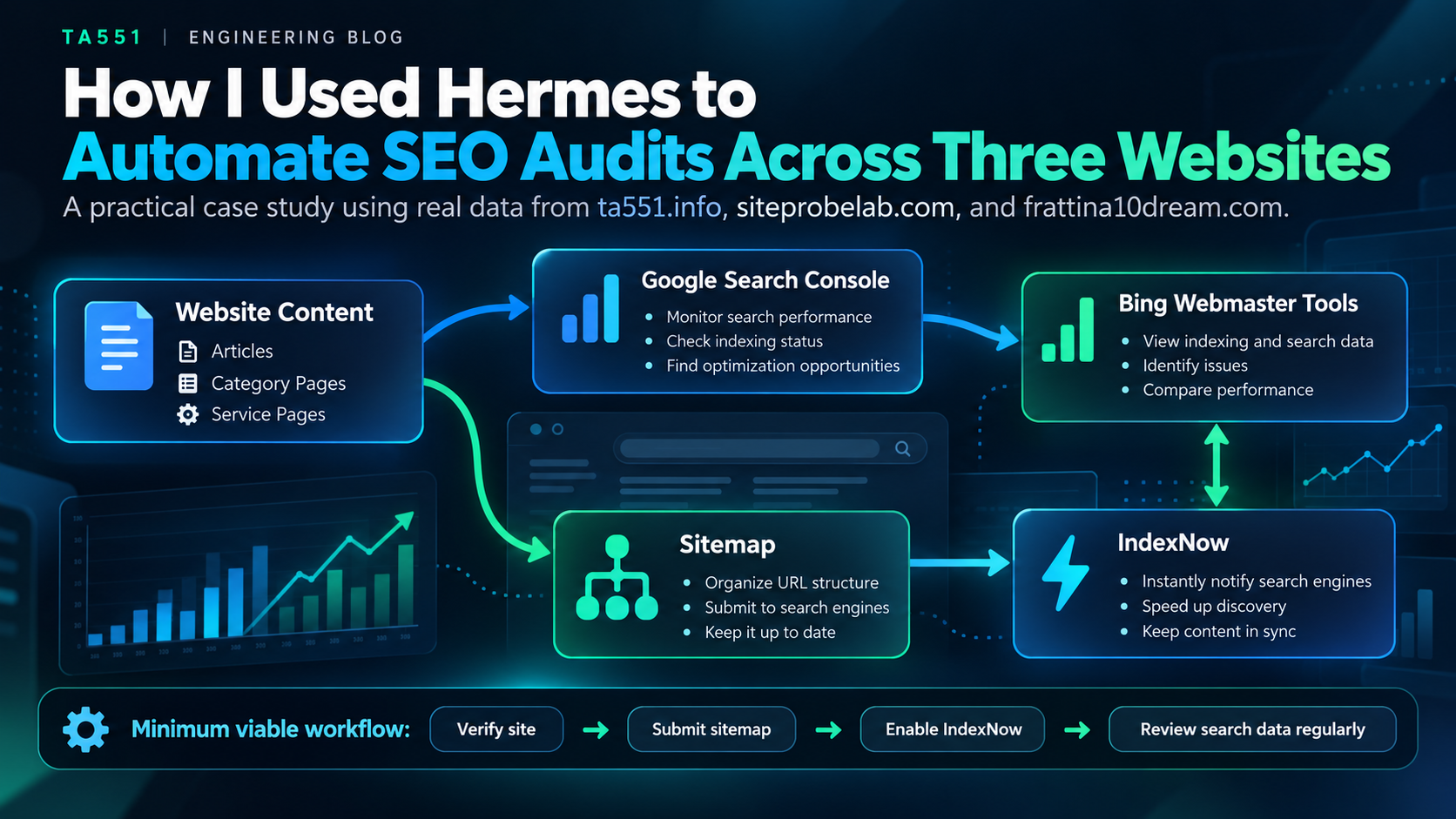
A sitemap returning HTTP 200 does not mean every page is indexed. A green status label does not prove a website is receiving visitors. And an automated report can produce a confident-looking warning even when the underlying tools disagree.
I ran into all three problems while building a read-only, AI-assisted SEO monitoring workflow with my local Hermes environment and SEO MCP tools. Instead of relying on one dashboard, I compared search-console data, individual URL inspections, technical signals, and generated reports for three different websites.
This is a case study of the process and the limitations I found—not a claim that AI automatically improves Google rankings.
The three websites behind the experiment
The audit covered projects with different purposes:
| Website | Type | Primary SEO question |
|---|---|---|
| ta551.info | IT portfolio and engineering blog | Are recently published technical articles being discovered and indexed? |
| siteprobelab.com | Website diagnostics SaaS prototype | Can search engines discover the initial landing page and guides? |
| frattina10dream.com | Apartment booking website | Is a small, mostly single-page website visible in organic search? |
Because the sites had different structures and ages, they were a useful test of whether one monitoring workflow could produce consistent, actionable reports.
How the Hermes SEO monitoring workflow worked
I used a local Hermes workflow with connected SEO MCP tools. The goal was to collect and compare available evidence, then save the results as Markdown reports. It was not an autonomous publishing system, and this run did not modify production websites.
The checks followed a repeatable sequence:
- Confirm Search Console access. Verify that the relevant domain properties are available before interpreting data.
- Review sitemap discovery. Examine submitted sitemaps and their reported processing or indexing counts.
- Inspect important URLs individually. Check the homepage and priority blog posts for crawl permissions, fetch results, canonical selection, and index status where available.
- Compare search visibility. Separate impressions, clicks, and reported search position instead of treating them as the same metric.
- Produce auditable notes. Save site-specific Markdown reports and a read-only comparison with observations, uncertainties, and next steps.
The output included reports for each domain, a separate blog-indexing check, verification notes, and a cross-site comparison. This made it possible to compare findings without manually switching between multiple dashboards each time.
What the October 15, 2026 snapshot showed
The combined report recorded the following search-performance observations:
| Domain | Google impressions in the measured report window | Google clicks | Important context |
|---|---|---|---|
| ta551.info | 3 | 0 | Individual inspections confirmed indexed pages despite a contradictory blog-sitemap counter. |
| siteprobelab.com | 0 | 0 | Newly configured site; its homepage inspection and sitemap totals did not tell the same story. |
| frattina10dream.com | 0 | 0 | A one-URL sitemap and insufficient page-level inspection evidence in that run. |
These are small snapshot values, not measured traffic growth. Three impressions do not mean three visitors, and zero impressions in an early reporting window cannot establish that a site is inaccessible or permanently excluded from Google. Although a report displayed a position near #2 for the tiny TA551 sample, that should not be interpreted as a stable ranking.
The report also listed two successfully processed Bing sitemaps for TA551. Bing information for the two other domains was absent in that particular snapshot; it should not be taken as a statement about any later setup changes.
The most useful finding: sitemap totals and URL Inspection disagreed
One aggregated report showed six submitted blog URLs and zero indexed URLs in the sitemap summary. If I had trusted that number alone, I might have concluded that the blog had failed to index.
But the page-level checks told a different story. The TA551 homepage and blog homepage had positive URL Inspection results. A separate blog check also found two technical articles indexed, while the third new article was not yet discovered in that snapshot.
The key lesson was methodological: a sitemap report is not a substitute for checking an individual URL. Search Console reports answer different questions and may update on different schedules. A URL can also be accessible and technically indexable without already appearing in search results.
I therefore changed how I interpret the output:
- Treat a sitemap count as a signal to investigate, not a final diagnosis.
- Use URL Inspection for priority pages and verify canonical URLs, crawl permissions, and indexing status.
- Keep HTTP availability, indexing, impressions, clicks, and conversions as separate facts.
- Preserve uncertainty instead of converting every empty metric into a “critical” failure.
Google makes the same important distinction in its documentation: a sitemap can help discover URLs, but submission does not guarantee indexing. Its URL Inspection tool is intended for examining individual URLs and troubleshooting indexing.
What the automated reports could not prove
The workflow was useful, but it had boundaries:
- GA4 visitors and sessions were not verified in this run. Search Console impressions cannot substitute for actual traffic analytics.
- Some analytics queries did not return page-level, query-level, or date-level details for the small impression count.
- A label such as
CRITICALwas a report classification based on limited inputs, not independent proof of a broken website. - A successful crawl or HTTP 200 check does not prove indexing, quality, ranking, or conversions.
- Results describe the October 15 snapshot, not necessarily the present state of a website.
Those limits are important for an AI-assisted workflow. A language model can summarize technical data quickly, but it must not invent evidence that an integration failed to return.
Turning the audit into a repeatable SEO process
The next version of my workflow will focus on change detection rather than dramatic scores. The planned improvements are to retain dated snapshots, compare them week by week, highlight newly discovered or missing URLs, prioritize human verification, and flag stale or incomplete data.
For a newly published engineering article, the manual follow-up remains straightforward: confirm the page returns HTTP 200, verify a self-referencing canonical where appropriate, link to it from the blog index, include it in the sitemap, inspect it in Search Console, and allow time for discovery. Repeated sitemap submission alone is not an indexing strategy.
That is why I prefer read-only reporting before automation that changes server configuration or publishes content. A trustworthy diagnostic workflow should explain what it checked, what it found, and what it still does not know.
Conclusion
My Hermes SEO experiment was not about replacing SEO expertise with AI. It was about reducing repetitive checks across multiple sites and making the evidence easier to compare.
The most valuable output was not a ranking score. It was catching a disagreement between summary counts and page-level evidence before taking unnecessary action.
I am continuing to develop this workflow alongside my TA551 engineering portfolio, including my articles on Wazuh and local AI-assisted SOC analysis and safer Nginx deployments.
Frequently asked questions
Can Hermes automatically improve my Google rankings?
No. In this case, Hermes helped organize SEO diagnostics and reporting. Ranking changes depend on many factors outside the workflow, and the audit did not demonstrate a ranking improvement.
Does an XML sitemap guarantee that pages will be indexed?
No. A sitemap is a discovery hint. Important URLs should also be accessible, internally linked where appropriate, and checked individually when troubleshooting.
Why can Search Console show zero indexed URLs while individual pages are indexed?
Aggregate sitemap reporting and individual URL Inspection are different views of the data. Their reported counts and updates may not align at a given moment, so confirm the state of the specific URL before making changes.
TA551 / RELATED
Related articles
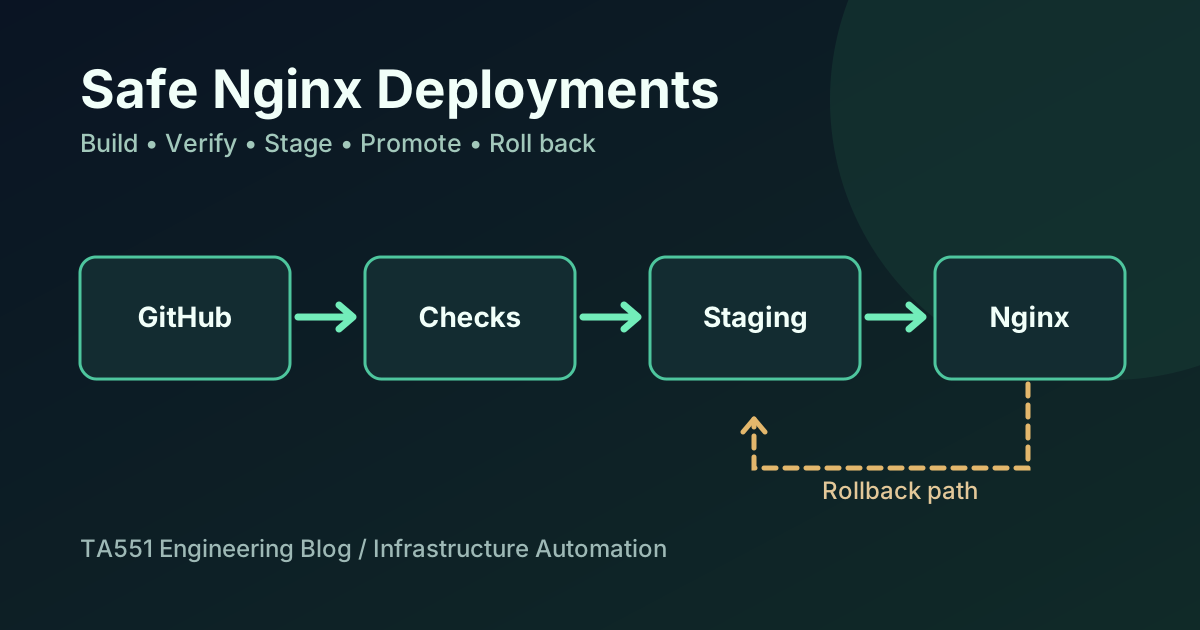
Automation
Safe Nginx Deployments with GitHub Actions and Rollback
An engineering case study of how I staged and verified a blog and portfolio update on a shared Nginx VPS without overwriting unrelated websites or API routes.
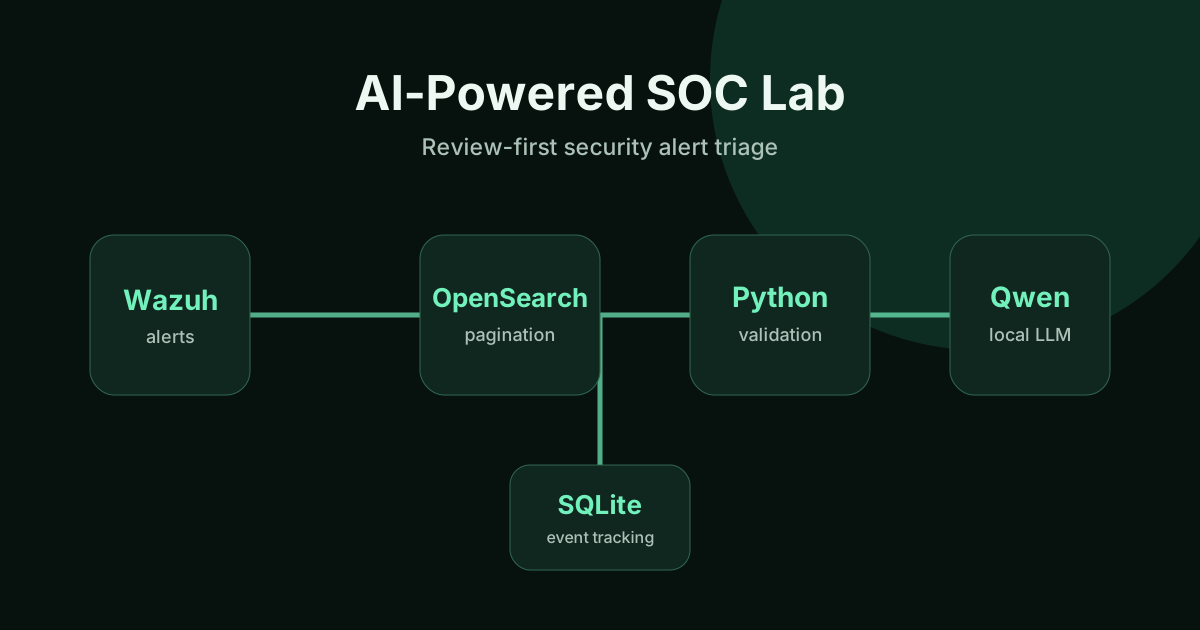
Cybersecurity
Building a Local AI SOC Lab with Wazuh and Qwen
How I built a review-first Wazuh SIEM lab with OpenSearch, Python, SQLite, and local Qwen AI—and validated pagination, event state, and safe incident triage.